




Yutong's Vertical Integration Strategy Reshapes the Global Bus Export Landscape
 By System Admin
1 week ago
By System Admin
1 week ago

Yutong Bus recently hosted a media event at its Zhengzhou headquarters, opening its R&D centers, smart manufacturing facilities, and design studios to journalists from across China. The sessions brought together senior executives including the company's technical director, engineering chief, branding head, domestic marketing deputy, and overseas marketing deputy. The discussions focused on three practical themes: how a Chinese commercial vehicle manufacturer is building a vertically integrated technology stack, how safety and intelligent driving features are being engineered into new energy buses, and how overseas markets are being developed through a market-by-market approach rather than a one-size-fits-all export push. For international buyers, dealers, and fleet operators evaluating Chinese bus and truck suppliers, the event offered a useful window into the operational depth behind the country's new energy commercial vehicle sector.
Building a Self-Controlled Supply Chain from Cell to Vehicle
Yutong's positioning rests on the principle that long-term competitiveness comes from owning core technologies rather than assembling off-the-shelf components. The company began its new energy R&D work in 1997, well before electrification became an industry priority, and has consistently allocated more than 5% of annual revenue to research and development. This sustained investment has produced a three-tier platform roadmap covering oil-to-electric conversion, dedicated electric platforms, and intelligent-electric integration, spanning light, medium, heavy, and extra-heavy chassis configurations.
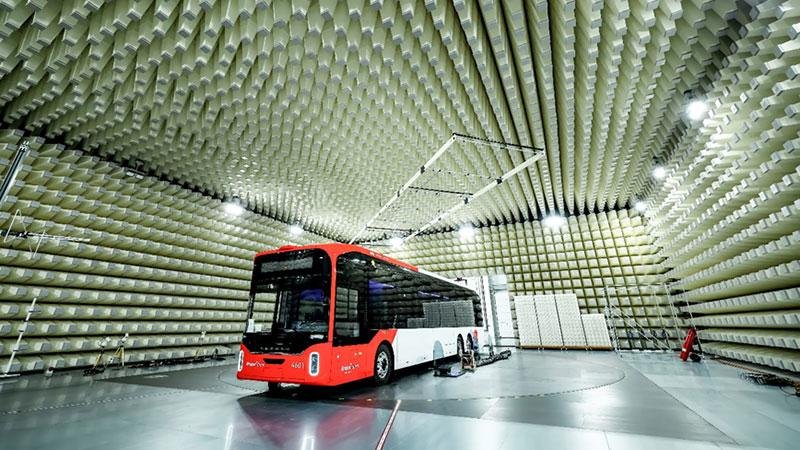
In battery technology, the company has introduced a "vehicle-and-battery parallel lifespan" system designed for 15 years or 1.5 million kilometers of reliable operation. Its high-speed flat-wire motors have received the highest-grade energy efficiency certification in the sector, and its cross-domain integrated C-architecture control system is now in volume production, with claimed performance improvements over the previous generation. To validate these technologies, Yutong has invested roughly 1 billion RMB into an electric bus control and safety engineering center, paired with a standardized vehicle proving ground that subjects prototypes to high-temperature, extreme-cold, and water-submersion testing. According to the technical director, the company has also participated in drafting hundreds of national and industry standards, treating standard-setting as part of its core mandate rather than a downstream activity.
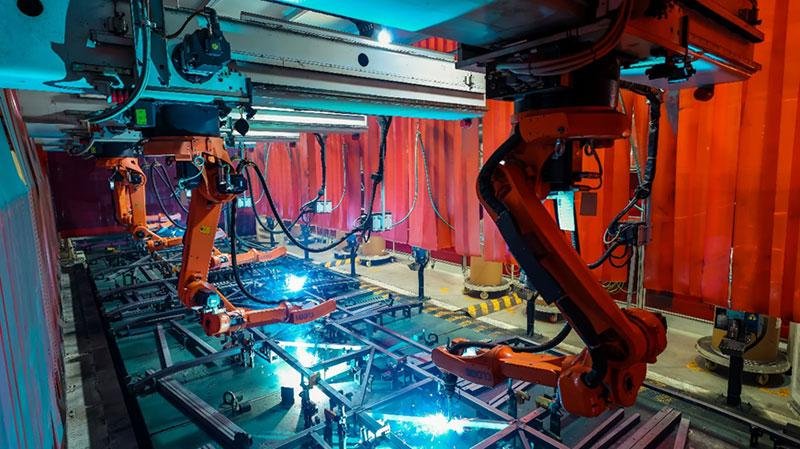
Manufacturing has followed a similar logic of in-house development. Since 2019, Yutong has applied AI and robotics across ten core production scenarios, including blanking, welding, painting, gluing, and inspection. The company reports more than 700 robotic systems operating alongside AI-driven quality controls, with 3D scanning and path planning reportedly compressing welding programming time and lifting body accuracy from plus or minus 5 millimeters to plus or minus 2 millimeters. Semi-finished component machining is handled through 24 sets of CNC machines linked to central control and smart overhead systems, with an annual capacity of 5.4 million parts across more than 10,000 product variants.
Safety-First Approach to Intelligent Driving Features
For the engineering team, intelligent driving features are evaluated primarily through the lens of safety outcomes. To identify the highest-risk scenarios, Yutong reportedly analyzed its own incident records over the past five years and broader industry data covering roughly a decade, then mapped those findings to four operating contexts: stationary, driving, blind-spot, and emergency assistance. The resulting feature set includes a door-open warning system that prevents doors from opening when hazards are detected, a forward and rearward start-inhibit function that blocks vehicle movement when obstacles are present, and forward collision warning with a reported prediction accuracy of up to 99.7% and decision response time as low as 0.02 seconds.
Additional features address specific bus operating risks. An inner-wheel-difference braking function is designed to stop the vehicle during right turns to protect pedestrians in blind zones, and a one-touch emergency control system collapses what the company describes as eight operating steps into a single action, reducing driver emergency response time from roughly five seconds to one second. According to the engineering chief, these systems have undergone approximately 12 million kilometers of real-world validation. The company also offers the Anruitong connected vehicle platform, which goes beyond passive maintenance to cover inspection, usage, charging, and repair workflows, with reported efficiency gains in mobile inspection and reductions in abnormal charging behavior that have translated into substantial annual savings for some fleet customers.
From Export Volume to Brand Presence in Overseas Markets
Yutong's overseas strategy reflects a shift from volume-driven exporting toward deeper market integration. According to figures shared during the event, Yutong held a 15.5% share of the European electric bus market in 2025, ranking first in that segment. For the first half of 2026, the company reported bus exports of 6,850 units, up 13.8% year on year, maintaining its leading position among Chinese bus exporters. The overseas marketing leadership emphasized that pricing in key European markets is now aligned with established local competitors, a positioning the company views as evidence of brand acceptance.
Market selection is described as deliberate: the company prefers to concentrate resources in markets with stable bilateral relationships and manageable trade conditions, applying a "one country, one strategy" model. In Kazakhstan, Yutong partners on a local KD assembly facility; in Qatar, the first overseas new energy commercial vehicle plant in the Middle East has been established; and overseas service personnel reportedly outnumber sales staff by more than two to one, supporting direct service shops, roaming service teams, and on-site guarantee models across the vehicle lifecycle. Corporate social responsibility programs, including a tree-planting initiative tied to each bus delivered and training programs for female drivers, are also positioned as part of the long-term brand-building effort.
For international buyers, dealers, and fleet operators, the implications are practical. Vertically integrated suppliers can offer more consistent parts availability, clearer technology roadmaps, and standardized service training across regions. The combination of in-house battery, motor, and control systems with AI-enabled manufacturing also suggests shorter customization lead times for export orders. Buyers evaluating Chinese bus and truck suppliers should look for evidence of overseas service infrastructure, local assembly or KD partnerships, and verifiable in-market references rather than relying on export volume figures alone.
Yutong's stated philosophy, summarized by its leadership as "being a slow company, because stable is the fastest speed," reflects a longer product and brand cycle than typical export-driven commercial vehicle transactions. Whether the same model can be replicated by mid-sized Chinese truck and bus exporters remains an open question, but the directional signal is clear: premium segments in Europe, the Middle East, Central Asia, and Latin America are increasingly reachable for Chinese new energy commercial vehicles, provided suppliers can back products with localized service and brand credibility.
Explore current new energy and diesel bus inventory on CVTrader's vehicle listings, connect with verified international dealers, or learn how to become a dealer on the CVTrader platform.
Featured Vehicles